You pray. You study or you work. You look after your family. And still something feels off. You're moving, but you couldn't tell anyone where you're heading.
That feeling is rarely laziness. It's a lack of direction. Most of us were taught that we were created to worship Allah, and we stopped there. We know the answer. We've never sat down and worked out what it means for our own life, with our own family, our own work and our own circumstances.
This guide is that sitting down. Twenty minutes, a pen and four questions. By the last page your purpose is written down, in your own words.
Why purpose comes first
Everything we teach starts here, and there's a reason for that.
A productive action is doing the right thing, at the right time, at an efficient rate. But what decides the right thing? You can't answer that without knowing what you're working towards. Eight hours of gaming is productive for someone who streams for a living, and a wasted day for a student two weeks from his exams. The action is the same. The purpose is different.
Without a purpose, every day becomes a list of things that feel urgent. You stay busy. You might even get a lot done. Then years pass and you realise most of it led nowhere you actually wanted to go.
أَفَحَسِبْتُمْ أَنَّمَا خَلَقْنَاكُمْ عَبَثًا وَأَنَّكُمْ إِلَيْنَا لَا تُرْجَعُونَ
Afahasibtum annama khalaqnakum 'abathan wa annakum ilayna la turja'un
"Did you think that We created you without purpose, and that you would not be returned to Us?"
Qur'an, Surah al-Mu'minun (23:115)
Worship is wider than you think
Islam is a religion of action. Worship is wider than salah and fasting. The work you do, the way you raise your children, the way you look after your parents, even your rest: all of it becomes worship when it serves a mission aimed at pleasing Allah.
So your purpose sits inside a bigger one. The overall purpose is the same for every believer, to worship Allah. The purpose within it is yours. For one person it's raising righteous children and providing an honest living. For another it's building something that serves the community. For another it's earning well so they can fund projects they could never run themselves.
Think of it like being handed a basket of ingredients and told to make the best meal you can. Everyone's basket is different. Your job isn't to make a cheesecake when you've been given the ingredients for bread. Look honestly at what's in front of you and make the best of it.
The four steps
The worksheet walks you through four parts. Do them in order, and don't skip one because it feels obvious.
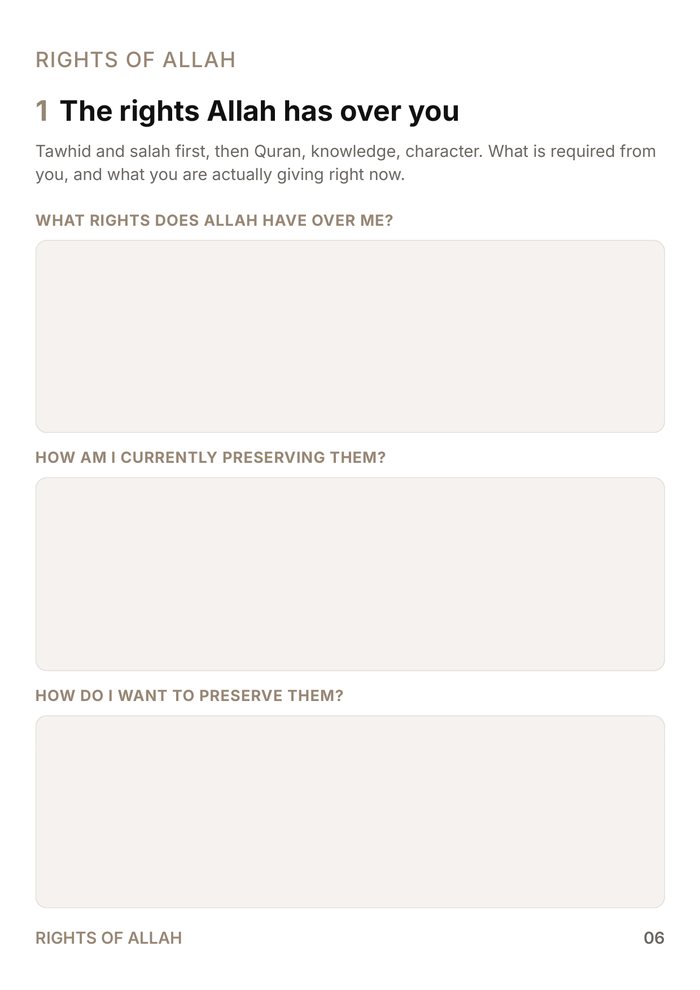
1. The rights Allah has over you
This comes first because everything else rests on it. Tawhid and salah, then the Qur'an, knowledge and character. You write down what is required of you, how you're preserving it right now, and how you want to preserve it.
For most people this is the most uncomfortable page. That's the point. If the foundation is cracked, a perfect timetable built on top of it won't hold.
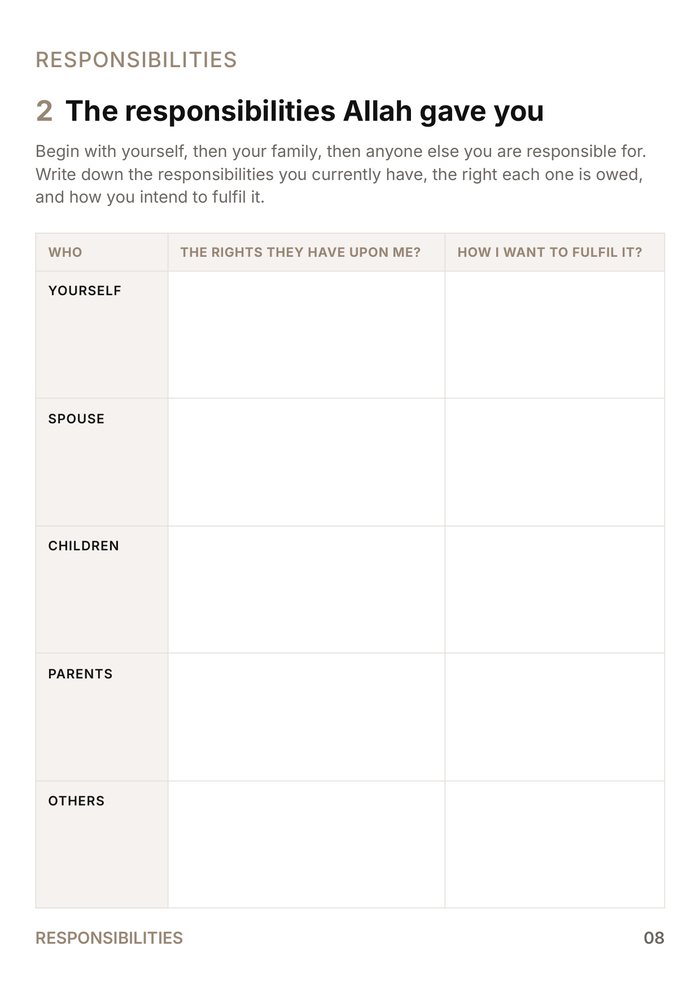
2. The responsibilities Allah gave you
Start with yourself, then your spouse, your children, your parents and anyone else you're responsible for. For each one, you write down the right they have over you and how you intend to fulfil it.
This is where purpose gets practical. A mother with young children has different responsibilities to a student living alone. Her twenty-four hours are not his twenty-four hours, and they shouldn't be judged the same way. Your responsibilities are the clearest signal of what you should be doing right now.
3. The blessings Allah gave you
Wealth, health, time, knowledge, family, community, skills. What were you given, how are you using it, and what is sitting idle?
Every blessing is also a test. If you're wealthy, you can support those who aren't. If you're strong, you can support the weak. If you're patient, you can support those who have been harmed. Your responsibilities show what you must do. Your blessings show what you could do.
4. The enemies of your mission
Every believer has them. A mindset, a sin, a person or environment, a fear. The worksheet asks you to tick which ones you have, name them exactly, describe how they attack you, and decide how you'll protect yourself.
Naming them matters. An enemy you can't name is one you'll keep losing to.
Writing it down
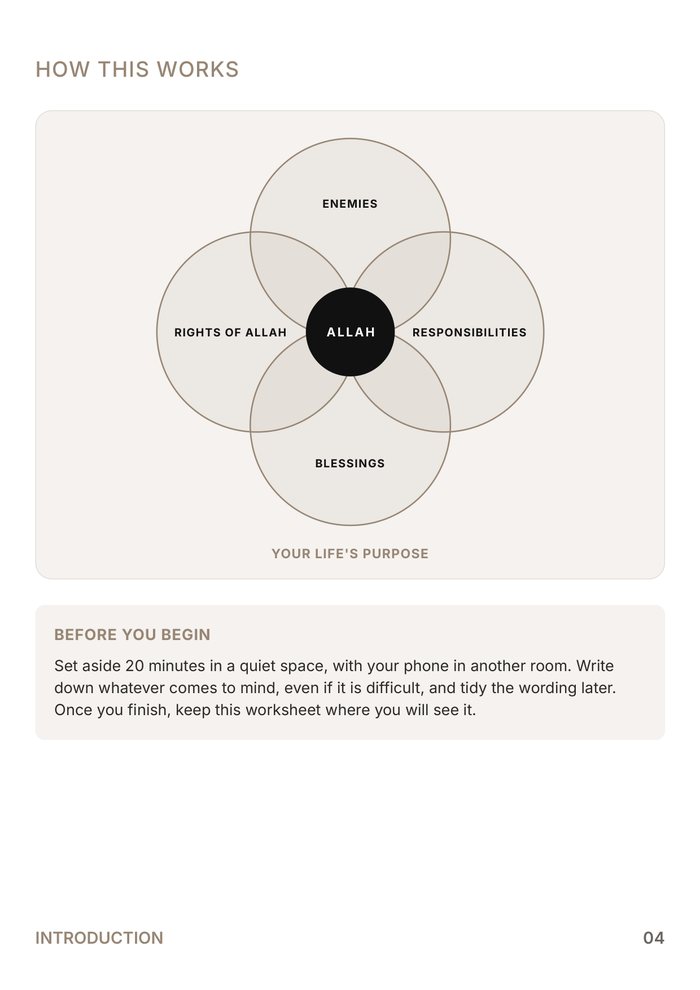
On the last page you bring the four together. The rights of Allah, your responsibilities, your blessings and your enemies are the framework of your purpose. They show what you should be doing now, and what you could achieve with what Allah has given you.
Then you write it as a personal mission, with Allah at the centre, and one thing you'll do this week to live closer to it. A purpose that only lives on paper hasn't done its job yet.
Start with yourself, then expand
Your purpose will change. Your responsibilities change as your life changes, and so do your blessings. The student becomes a husband. The husband becomes a father. The father becomes the one his parents lean on. Each stage asks something different of you.
Start with yourself. Then your household. Once those are in order, look outward. You've managed to provide for your family? Don't stop there. Can you benefit your community? Can you start something that outlives you?
Come back to the worksheet whenever your life shifts, and write your purpose again.
How to use the guide
- Watch the video above first. It walks through the same four steps.
- Set aside twenty minutes somewhere quiet, with your phone in another room.
- Write whatever comes to mind, even if it's messy. Tidy the wording later.
- Keep the finished page somewhere you'll see it.
We ask Allah to make us of those who have lofty missions and lofty purposes.